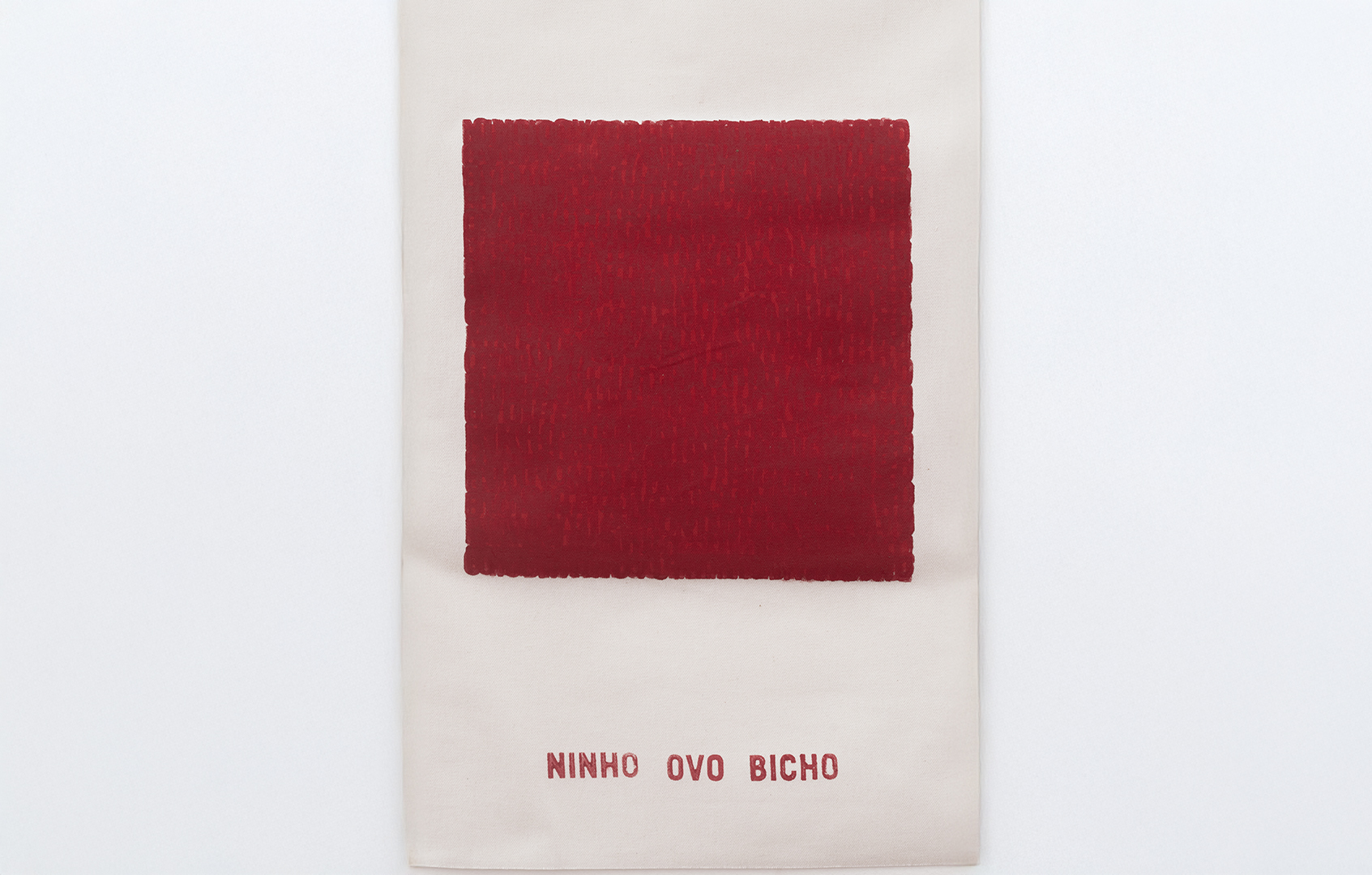
Ninho Ovo Bicho (Tributo Neoconcreto), 2022
Tinta acrílica (carimbo) sobre tecido de algodão
Acervo MNBA/IBRAM
A obra de Heleno Bernardi pode, à primeira vista, soar como um desvio numa exposição dedicada à natureza e à materialidade. Mas essa estranheza é, talvez, a sua chave: um indício de que a arte raramente se oferece por inteiro na superfície sensível, desdobrando seus sentidos em camadas sucessivas de experiência. Ninho Ovo Bicho é, antes de tudo, uma homenagem a Hélio Oiticica, Lygia Pape e Lygia Clark — três vértices do neoconcretismo — condensando, em três palavras, sinais de suas obras e presenças ainda pulsantes na arte brasileira. A peça de Bernardi se constrói pelo gesto repetitivo do carimbo, que sobreposto, funda o quadrado vermelho. Vermelho que atravessa a história como pigmento ancestral das pinturas rupestres, metáfora da vida e da morte, do sangue e da carne. No caso dos neoconcretos, essa cor pura, vibrante, retoma a experiência como fundamento da obra: no espaço entre corpo e forma, tempo e cor, como afirmou o Manifesto Neoconcreto, a geometria se abre à expressão de realidades humanas complexas. Assim, em Bernardi, as palavras — ninho, ovo, bicho — tornam-se sinais instáveis de uma experiência estética que exige o corpo inteiro: o do artista, que repete o gesto, e o do espectador, que se vê implicado nessa fricção entre memória, cor e presença.
Ninho Ovo Bicho (Neoconcrete Tribute), 2022
Acrylic paint (stamp) on cotton fabric
MNBA/IBRAM Collection
At first glance, Heleno Bernardi’s work may seem like a deviation in an exhibition dedicated to nature and materiality. But this strangeness is perhaps its key: an indication that art rarely offers itself entirely on the sensory surface, unfolding its meanings in successive layers of experience. Ninho Ovo Bicho is, above all, a tribute to Hélio Oiticica, Lygia Pape, and Lygia Clark—three vertices of neo-concretism—condensing, in three words, signs of their works and presences still pulsating in Brazilian art. Bernardi’s piece is constructed by the repetitive gesture of stamping, which, when superimposed, forms the red square. Red runs through history as the ancestral pigment of cave paintings, a metaphor for life and death, blood and flesh. In the case of the neo-concretists, this pure, vibrant color takes up experience as the foundation of the work: in the space between body and form, time and color, as stated in the Neo-Concrete Manifesto, geometry opens itself to the expression of complex human realities. Thus, in Bernardi, the words — nest, egg, animal — become unstable signs of an aesthetic experience that demands the entire body: that of the artist, who repeats the gesture, and that of the viewer, who finds himself implicated in this friction between memory, color, and presence.